
RYAN TATE
CLIP
From The Wall Street Journal/California
Wednesday, August 18, 1999
(page CA-2)
Mexico Aims To Stop Guns At the Border
Mexico has a message for Americans traveling south: Leave your guns at home.
By Ryan Tate
Staff Reporter of The Wall Street Journal
SAN DIEGO -- Mexico has a message for Americans traveling south: Leave your guns at home.
In a joint campaign to be launched today, the Mexican government, along with U.S. border authorities and the California Department of Transportation, will be publicizing the stiff penalties -- including prison -- that Americans can face if found with firearms across the international frontier.
The campaign includes posters, brochures, freeway signs and radio broadcasts, all aimed at warning border travelers that bringing a gun into Mexico without special permission is illegal and can mean up to 30 years in a Mexican prison, even if the trafficking was unintentional.
The effort comes after an increase in violations by U.S. citizens in Mexico: 197 Americans were arrested there last year on weapons violations, up from 72 one year earlier, according to the U.S. State Department. That surge in arrests came despite warning signs posted near freeway border crossings by Caltrans three years ago.
For the new campaign, those signs -- which displayed legalese citing Mexican gun statutes -- are being replaced with billboards warning simply, "Guns Illegal in Mexico."
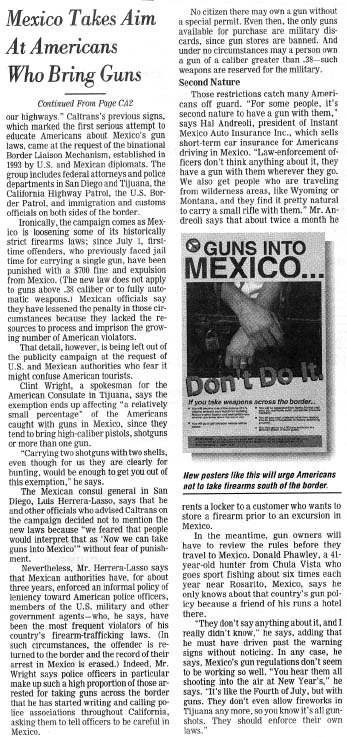
What's more, a slew of organizations, including the Automobile Club of Southern California, the Mexican Consulate here, the American Consulate in Tijuana, the U.S. Border Patrol and customs officials on both sides of the border, are helping spread the word. They will start with posters and inserts warning, under a picture of hands resting on prison bars, that "once you cross the border with a firearm or ammunition it is too late . . . . You will be arrested and sent to jail." In addition, a brief radio message, carried at 1610 on the AM dial, is mixed with miscellaneous warnings about cross-border travel. "Permits are required to export firearms," a male announcer says. "Guns, ammo or explosives are illegal in Mexico."
Caltrans Director Jose Medina says his agency is spearheading the campaign in California "because [traffickers] travel on our highways." Caltrans's previous signs, which marked the first serious attempt to educate Americans about Mexico's gun laws, came at the request of the binational Border Liaison Mechanism, established in 1993 by U.S. and Mexican diplomats. The group includes federal attorneys and police departments in San Diego and Tijuana, the California Highway Patrol, the U.S. Border Patrol, and immigration and customs officials on both sides of the border.
Ironically, the campaign comes as Mexico is loosening some of its historically strict firearms laws; since July 1, first-time offenders, who previously faced jail time for carrying a single gun, have been punished with a $700 fine and expulsion from Mexico. (The new law does not apply to guns above .38 caliber or to fully automatic weapons.) Mexican officials say they have lessened the penalty in those circumstances because they lacked the resources to process and imprison the growing number of American violators.
That detail, however, is being left out of the publicity campaign at the request of U.S. and Mexican authorities who fear it might confuse American tourists.
Clint Wright, a spokesman for the American Consulate in Tijuana, says the exemption ends up affecting "a relatively small percentage" of the Americans caught with guns in Mexico, since they tend to bring high-caliber pistols, shotguns or more than one gun.
"Carrying two shotguns with two shells, even though for us they are clearly for hunting, would be enough to get you out of this exemption," he says.
The Mexican consul general in San Diego, Luis Herrera-Lasso, says that he and other officials who advised Caltrans on the campaign decided not to mention the new laws because "we feared that people would interpret that as `Now we can take guns into Mexico'" without fear of punishment.
Nevertheless, Mr. Herrera-Lasso says that Mexican authorities have, for about three years, enforced an informal policy of leniency toward American police officers, members of the U.S. military and other government agents -- who, he says, have been the most frequent violators of his country's firearm-trafficking laws. (In such circumstances, the offender is returned to the border and the record of their arrest in Mexico is erased.) Indeed, Mr. Wright says police officers in particular make up such a high proportion of those arrested for taking guns across the border that he has started writing and calling police associations throughout California, asking them to tell officers to be careful in Mexico.
No citizen there may own a gun without a special permit. Even then, the only guns available for purchase are military discards, since gun stores are banned. And under no circumstances may a person own a gun of a caliber greater than .38 -- such weapons are reserved for the military.
Those restrictions catch many Americans off guard. "For some people, it's second nature to have a gun with them," says Hal Andreoli, president of Instant Mexico Auto Insurance Inc., which sells short-term car insurance for Americans driving in Mexico. "Law-enforcement officers don't think anything about it, they have a gun with them wherever they go. We also get people who are traveling from wilderness areas, like Wyoming or Montana, and they find it pretty natural to carry a small rifle with them." Mr. Andreoli says that about twice a month he rents a locker to a customer who wants to store a firearm prior to an excursion in Mexico.
In the meantime, gun owners will have to review the rules before they travel to Mexico. Donald Phawley, a 41-year-old hunter from Chula Vista who goes sport fishing about six times each year near Rosarito, Mexico, says he only knows about that country's gun policy because a friend of his runs a hotel there.
"They don't say anything about it, and I really didn't know," he says, adding that he must have driven past the warning signs without noticing. In any case, he says, Mexico's gun regulations don't seem to be working so well. "You hear them all shooting into the air at New Year's," he says. "It's like the Fourth of July, but with guns. They don't even allow fireworks in Tijuana any more, so you know it's all gunshots. They should enforce their own laws."
Clip image 1
Clip image 2